On the waterMallorca
Boat rental in Alcúdia and the shallow northern bay
May–Oct
The bay between Alcúdia and Artà is the most forgiving water on Mallorca — sand, gentle depths and a long beach you can run for miles. It is also open to the north-east, which changes everything on the wrong day. What is rentable in Port d'Alcúdia, where to actually go, and the anchoring rule that decides where you can stop.

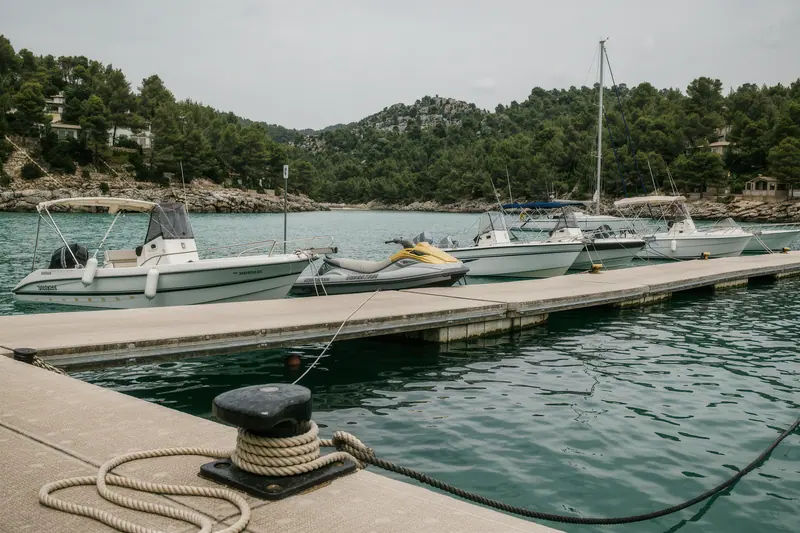
The northern bay is the one part of Mallorca where the sea behaves like a swimming pool. From the harbour mouth at Port d’Alcúdia the water runs out gently over sand for a long way, the shore curves round through Platja de Muro and Can Picafort towards Colònia de Sant Pere, and there is nothing hard to hit between one end and the other.
That is the whole case for renting a boat here rather than in Palma. It is also why the fleet is what it is: open day boats, a lot of licence-free craft, a handful of larger motorboats, and comparatively few sailing yachts.
The bay, in the terms that matter on the water
Roughly fifteen kilometres from the Alcúdia side across to the Artà side, with a long sandy southern shore in between and s’Albufera, the wetland, sitting behind the dunes. The depths stay modest across most of it. The two ends are completely different animals.
- North-west end — Cap des Pinar and the Victòria peninsula. Steeper, pine down to the water, small stony coves. Coll Baix is the well-known one and it is far easier to reach by boat than on foot.
- The middle — Platja de Muro to Can Picafort. Shallow, sandy, busy with swimmers and hire craft, dotted with buoyed bathing zones you must stay outside of if you have an engine.
- South-east end — Colònia de Sant Pere and Betlem, under Cap de Ferrutx. Quieter every year you go further along. This is the run that makes a day boat worth hiring.
A day that works
The shape below is what most people should do, and almost nobody does, because they set off at eleven.
- 09:00 — leave the pontoon. The bay is at its flattest in the first two hours and the crossing towards the Artà side is a different experience before the breeze.
- 09:30 — run south-east, past Can Picafort and on towards Colònia de Sant Pere. Twelve to fifteen kilometres depending on your boat, comfortable at modest speed.
- 10:30 — anchor off Betlem or one of the small coves under Cap de Ferrutx. Find sand. Swim before anyone else is there.
- 13:00 — start back, with the breeze behind you rather than in your face.
- 15:00 — the Victòria side, if there is anything left in the fuel and the sea state allows it. Coll Baix from the water in the afternoon light is the best twenty minutes of the day.
- 17:00 — back inside, well before the return slot rather than on it.
The reason to run the bay clockwise, out to the south-east first, is the same reason cyclists do their long leg into the wind: the afternoon breeze here comes in across the bay, and you would rather punch it at nine than at three.
The two rules people break
Bathing zones. The swimming areas off the main beaches are buoyed and powered craft stay outside them. On a stretch of coast this heavily used, that line is watched. Slow right down as you close the shore and approach the beach at walking pace or not at all.
Seagrass. Posidonia meadows are protected across the Balearics and anchoring on them is prohibited. In this bay the meadows are extensive, and the patches of clean sand between them are what you are aiming for. From the surface at midday the difference reads clearly — sand is pale, the meadow is dark — but at either end of the day, or with a ripple on the water, it does not. Get it identified during the briefing, and if in doubt move until the bottom underneath you is unambiguous.
What it costs, roughly, and what moves it
Prices here follow the season hard. A small licence-free open boat for a half day typically sits in the low hundreds of euros in high season and noticeably less in May or October, with fuel usually extra. A larger motorboat needing a certificate runs several times that, and a skippered day boat adds the skipper’s day rate on top.
Three things move the number more than the boat does. August, obviously. Weekends, because the local demand is real here and not only tourist demand. And fuel, which on a planing boat driven hard for six hours can add a third again to what you thought you were paying.
| Month | Sea temperature | Wind pattern | Availability |
|---|---|---|---|
| May | Cool, swimmable | Variable, often calm mornings | Wide open |
| June | Comfortable | Reliable afternoon breeze | Good |
| July–Aug | Warm | Breeze plus crowds | Book ahead, pay peak |
| Sept | Warmest of the year | Settled, occasional gregal | The best month here |
| Oct | Cooling | First northerlies arrive | Cheap, weather-dependent |
Whether to rent here at all
If you are staying anywhere between Alcúdia and Artà, yes — this is your water and it is a good deal better than driving across the island to hire something elsewhere.
If you are staying in Palma, think twice. The drive is around an hour each way, which is a large part of a day boat’s value gone, and Palma bay has its own licence-free fleet on your doorstep. The exception is a north-easterly-free forecast in September, when the northern bay is genuinely worth the drive and the south is not.
And if you are choosing a boat for a whole family week rather than a day, the shallow northern water is one of the strongest arguments in favour of a catamaran, because draught stops being an abstract number the moment you want to anchor close in on a sandy shelf. The same bay that makes a day boat easy makes a deep-keeled monohull sit further out than you want it to.
What to check before you book
- Ask what happens to your booking in a fresh north-easterly. The bay is open to it and a day that is fine at the pontoon can be unusable off Can Picafort.
- Confirm the operating limit. Most day hires from here are kept inside the bay, which excludes Formentor and the Cala Sant Vicenç side.
- Get the sand and seagrass shown to you on the chart at the briefing. Anchoring on posidonia is prohibited and the meadows in this bay are extensive.
- Check the draught of the boat against where you plan to stop. The southern shore shoals a long way out and grounding on sand still counts as damage.
- Ask whether a bimini or any shade is fitted. There is none on most open day boats and the bay has no cliffs to sit under.
- Confirm the fuel arrangement and where the fuel berth is before you leave the pontoon.
Questions people actually ask
- Is Alcúdia bay good for a first time renting a boat?
It is the best water on the island for it. The bay is broad, shallow and sandy, the bottom shelves gently rather than dropping away, and there are no rocks to hit for miles once you are clear of the harbour entrance. Compared with the cliffs and deep anchorages of the north-west it is an entirely different level of difficulty.
- What wind spoils a day on the northern bay?
The gregal, the north-easterly. The bay faces roughly north-east, so that wind blows straight in over a long fetch and builds a short steep sea across shallow water very quickly. A morning that starts flat can be uncomfortable by early afternoon. A northerly Tramuntana is partly blocked by the Formentor peninsula but still sends swell round the corner.
- Can you take a rented boat from Alcúdia round to Formentor?
Most day hire contracts keep you inside the bay, and rounding Cap des Pinar puts you on an exposed coast with deep water and no shelter. If the operator does allow it, treat it as a settled-weather trip only and go early. The stretch between the cape and Formentor is beautiful and it is not beginner water.
- Where can you anchor in Alcúdia bay?
On sand, and only on sand. Seagrass meadows are protected across the Balearics and there are large areas of them in this bay, including in the places that look most inviting. Official mapping shows where the meadows are and the rule is enforced from the air. Ask for the sand patches at your intended stops to be identified during the briefing.