On the waterMallorca
What you can take out in the Balearics without a licence
Apr–Oct
There is a small class of boat you can rent in the Balearics on a briefing rather than a certificate, and a much larger class of boat people assume is in it. What the licence-free category actually is, how far from shore it lets you operate, what that means from Palma, Sóller, Alcúdia and Portocolom, and the two upgrades worth doing instead.
Every summer a good number of people arrive in Mallorca believing they can rent a boat because they have driven one before. Some of them can. The category exists, it is real, and it accounts for a lot of the small open craft you see buzzing between the calas on a July afternoon.
It is just much smaller than the mental picture. The licence-free class is defined by engine power and hull length, both set nationally, and the boats in it are open, modest and slow. Everything else — including the sort of thing most people would call a speedboat — needs a certificate.
What the category actually gets you
A licence-free hire in the Balearics is a package of four things, and none of them is the boat on its own.
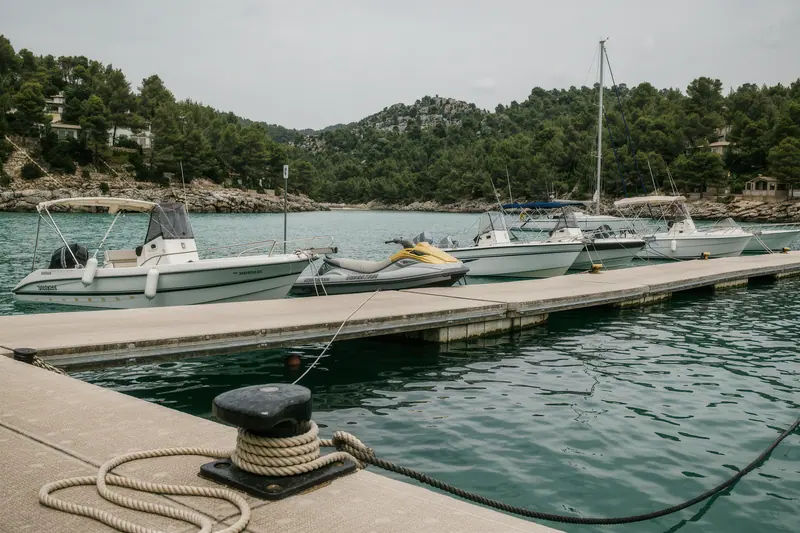
- A small open boat, typically four to five metres, with an outboard whose power sits under the national threshold.
- A briefing at the pontoon: starting, stopping, the kill cord, the anchor, the radio or the phone number, and the operating area drawn on a laminated chart.
- An operating area, expressed as a distance from the coast and often tightened further by the company to a named stretch.
- A daylight window. You go out in the morning and you come back before evening. This is not a category that operates after dark.
The thresholds behind all of this are national and they have moved. Do not accept a website’s summary of them, and do not accept “you don’t need anything for this one” as an answer. Ask the operator for the engine power and hull length of the boat you are actually being handed, in writing, and check that against the current rules. If the boat turns out to be outside the class, the consequences are yours to carry, not theirs.
What that means from each base
The distance limit sounds abstract until you put it on this island’s map. Then it becomes very concrete, because Mallorca has four completely different coasts and the same limit produces four completely different days.
| Base | What is in range | What is not | Verdict |
|---|---|---|---|
| Palma bay | Illetes, Portals Vells, Cala Blava, the beaches under Cap Blanc | Cabrera, Dragonera, the Tramuntana | Good, but busy water |
| Port de Sóller | The harbour, the cliffs to Cap Gros and Torre Picada | Sa Calobra, anywhere in a northerly | Scenic, short, weather-dependent |
| Alcúdia and Pollença | Most of the northern bay, Cala Sant Vicenç in calm | Formentor in a fresh gregal | The best of the four |
| Portocolom and the south-east | Cala Varques, Cala Marçal, the calas towards Santanyí | Anything round Cap de ses Salines | Excellent in settled weather |
The pattern is that a licence-free boat is a coast-hopping machine. It is very good at getting you to a cala with no road down to it and letting you swim off the stern, and it is bad at everything that involves distance.
Cabrera is the clearest example of what is out of reach. It is an open crossing from anywhere on Mallorca, it is a national park with a permit and mooring system attached, and no licence-free hire is going to take you there.
The two things the briefing usually rushes
Anchoring. Posidonia seagrass meadows are protected across the Balearics and anchoring in them is prohibited. The meadows are exactly where you want to stop: sheltered, clear, sandy-looking from the surface. The rule is enforced, there is official mapping showing where the seagrass is, and a fine is capable of eating your deposit several times over. Ask for the sand patches to be pointed out on the chart during the briefing rather than working it out from the colour of the water at midday.
Fuel. Small outboards drink more than people expect when driven at full throttle, which is how they are usually driven. Establish whether the tank comes full and goes back full, whether you are refunded for what is left, and where the fuel berth is — there are far fewer in the Balearics than there are marinas.
When to upgrade instead
Three situations where the licence-free route is the wrong answer.
You want to go somewhere specific and it is more than a few miles away. The limit will stop you, and if it does not, the weather will.
You are four or more adults. These boats are small and open. A day on one in August, with no shade and nowhere to sit that is not fibreglass, is endurance rather than leisure.
You want to do this more than once. Spain has a short entry-level licence that takes a day or two and covers a usefully larger class of boat close to shore. If you are on the island for a fortnight, or you come back every year, it is the better purchase — and it is the step that eventually leads to a proper charter with a cabin, a galley and somewhere to get out of the sun.
The one genuine sweet spot for licence-free hire is a half day in the northern bay or off the south-east calas, three or four people, flat morning, back before the breeze. Booked that way it is one of the better things you can do on this coast for the money. Booked as a substitute for a boat, it disappoints by lunchtime.
What to check before you book
- Get the operator to state the engine power and hull length of the exact boat, and confirm in writing that it falls in the licence-free class.
- Ask what distance from shore your hire is limited to and whether that limit is in the contract or only in the briefing. It is the number that decides where you can go.
- Confirm the return time and whether night operation is excluded. Licence-free hire is generally a daylight arrangement.
- Ask to see the boat's charter authorisation. Boats rented commercially in the Balearics need to be registered for it, and unlicensed hire is your problem as well as theirs.
- Check whether fuel is included, prepaid or refunded, and where the fuel berth is. Fuel is the item that turns a cheap half day into an expensive one.
- Have the anchoring rules explained on the chart, not in general terms. Seagrass meadows are protected across the Balearics and dropping on them is an offence.
- Photograph the hull, the outboard and the fuel gauge at the pontoon before you leave, with the operator standing there.
Questions people actually ask
- How big a boat can you rent in Spain without a licence?
Small and low-powered — the thresholds are set nationally in terms of engine power and hull length, and they are lower than most people expect. They also change, so no operator page should be treated as current until they confirm it for the boat you are being given. Ask for the power and length figures and check them against the current national rules rather than assuming a boat qualifies because it is being rented to you.
- How far offshore can you go on a licence-free hire?
There is a distance-from-shore limit and a daylight restriction attached to the category, and the rental company will usually impose a tighter operating area than the law does. In practice you are hugging the coast within sight of where you started. That rules out anything involving an open crossing, including Cabrera and the run to Dragonera from the wrong side.
- Is a licence-free boat worth it for a family day?
For a beach-hopping day on a sheltered coast, yes. You get to a cala that is difficult to reach by road, you swim off the boat, and you are back by late afternoon. It is not worth it as a substitute for a charter — the boats are small, slow, open to the sun and uncomfortable in any chop, and half a day is usually enough.
- What qualification should I get if I want more?
Spain has a short entry-level boating licence that covers a larger class of craft close to shore and can be completed in a day or two, and above that the recreational skipper certificate that charter companies recognise. An International Certificate of Competence is widely accepted for charter here. Which one you need depends on the boat, so decide the boat first.