PlacesMallorca
Villas with a private mooring, and what that phrase covers
May–Sep
Four very different things get advertised under the same two words, and only one of them is a jetty you can tie a boat to. Where these houses actually are on Mallorca, what to ask about length, depth and shelter before you believe the photograph, and why the Spanish coastal law makes the beach in front of the house public.
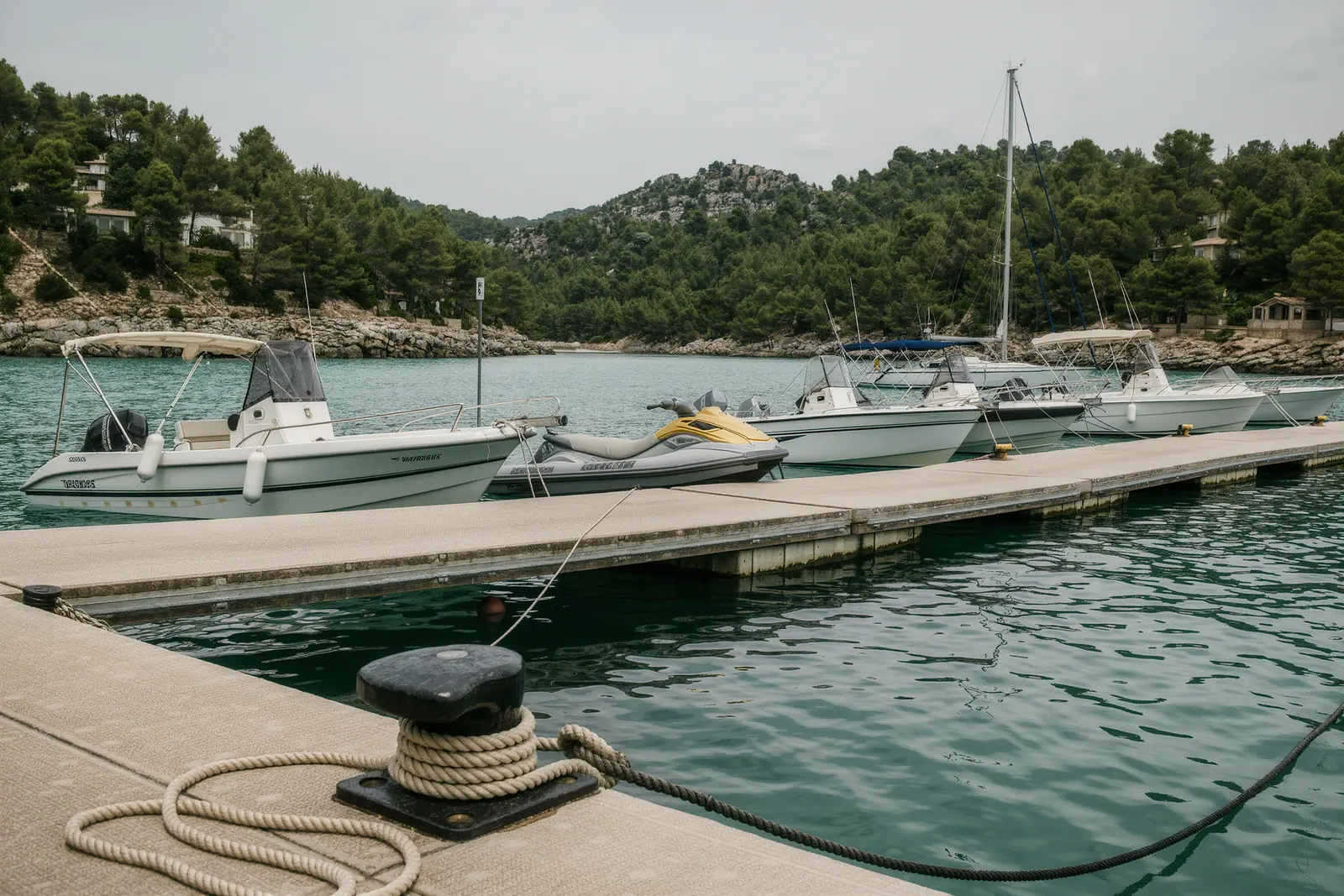
Read enough Mallorcan villa listings and you will meet the phrase “with private mooring” attached to houses that are, on inspection, ten minutes’ walk from any water a boat could reach. It is one of the loosest terms in the island’s rental market, and the difference between the versions of it is the difference between a holiday spent stepping off your terrace onto a boat and a holiday spent driving to a marina.
The four things the phrase covers
| What is advertised | What it actually is | What you can do with it |
|---|---|---|
| Private jetty or boathouse | A structure on the shore held under a concession, usually historic | Tie up a boat of a stated length, if the depth allows |
| Berth included | A marina berth the owner holds, made available with the let | Everything a marina berth does, subject to their contract |
| Mooring buoy | A swinging mooring in a bay, sometimes shared | Leave a boat on it and get ashore by tender |
| Water access | Steps, a slipway or a path to the shore | Launch a paddleboard or a small tender. Nothing else |
Only the first two let you step aboard with the shopping. The third means a tender and a wet crossing every time somebody forgets something; the fourth means the photograph was taken from a rock.
None of them is dishonest, exactly. They are all reasonably described as private water access by an agent writing quickly. The remedy is to ask a specific question rather than accept a general phrase: what will be alongside my house, and how long may it be.
Where the houses are
Geography decides this, and it explains why the stock is so small.
The east and south-east inlets. The natural harbours at Portocolom and Porto Cristo, and the narrow steep-sided calas around Portopetro and Cala d’Or, are where private jetties cluster. These are drowned river valleys with deep, calm water and houses built right down to it, and they are the closest thing Mallorca has to canal-side living.
The Tramuntana coast. A handful of old estates have traditional boathouses on the shore — the low stone sheds with a slipway that were built for working boats. Charming, historic, and mostly suitable for something small. This coast is a lee shore in a northerly and there is very little shelter along its whole length.
The bays west of Palma. Port d’Andratx and the developments towards Portals have plenty of waterfront villas, but the water in front of them is generally managed by a marina. What transfers with the house is a berth agreement, not a piece of shore.

The four numbers that decide whether it works
Length overall. Ask for the maximum the mooring takes, and be honest about your boat including any bathing platform and davits. Jetties in the east coast inlets are frequently sized for something in the eight to twelve metre range.
Depth alongside. The Balearics have almost no tide, which sounds like good news and mostly is: the depth you are told is the depth you get. What it also means is that a shallow berth does not become deep twice a day. Get a figure.
Shelter. Every berth on this island has a wind direction that ruins it. The east coast inlets are calm in almost everything and uncomfortable in a strong easterly, which is exactly the swell direction that runs straight in. Ask the owner which wind they move the boat for.
Services. Water and power on the jetty, or not. If not, you will be filling cans, and a week of that gets old.
What the coastal law does to the photographs
Spain’s coastal legislation places the shore in the public domain and provides for a right of passage along it. In practice, on Mallorca, this means the strip at the water’s edge below a waterfront villa is public, and people walk it.
That is not a small detail if you have booked the house on the strength of the terrace pictures. What a good property can offer is exclusive access — the only path down to the water goes through its land — which delivers most of the privacy without the legal fiction. What no property can offer is a private beach, and any listing that claims one is worth a second look for what else it is prepared to imply.
The same body of law is why these houses are rare. A jetty on the shore exists under a concession, and concessions are neither casually granted nor easily transferred, so the supply of houses with real moorings is essentially fixed.
Booking, deposits and the changeover
These houses behave like the top of the villa market generally. Saturday changeovers, minimum stays that stretch to two weeks in the peak, deposits in the thousands held against damage, and a booking cycle that runs a year ahead. Repeat guests take a large share of the good ones before they are ever advertised, so the practical route in is to ask an agent in September what will be free the following August.
Rates through the season swing enormously — a house that lets for a moderate weekly figure in May can be several times that in the first half of August — and the mooring is part of what you are paying the premium for, which is worth remembering when you decide how much you will use it.
The recommendation nobody in the market will make
For most parties, the mooring is worth less than the price difference it carries. It ties you to a specific stretch of coast, it constrains the boat you can bring, and it is unusable on the days the wind is wrong.
Unless you are bringing your own boat, the better arrangement is usually to rent the house you actually want to live in — which may well be inland and cheaper — and to take the boat separately, bareboat or with a skipper out of Palma, where the fleet is deep and the shore support is real. You lose the step-aboard convenience. You gain the ability to choose a boat that suits the week rather than one that suits the jetty.
What to check before you book
- Ask what the mooring legally is: a concession attached to the property, a marina berth held by the owner, a buoy, or a slipway. The word covers all four.
- Get the maximum length overall and the depth alongside in writing, and match them against the boat you intend to bring or charter.
- Ask which wind direction makes the mooring unusable, because on this coast every berth has one.
- Confirm whether marina fees, water and electricity at the berth are inside the rent or billed separately.
- Check whether a tender, fenders and lines come with the house or whether you are expected to arrive with them.
- Ask who to call if the boat drags at three in the morning, and whether anybody local looks after the mooring.
- Remember the shoreline strip is public in Spain. Do not book on the assumption the beach below the terrace is yours.
Questions people actually ask
- Can a Mallorcan villa really have its own mooring?
Some genuinely do. They are mostly older properties on the sheltered south-east and east coast inlets, or estates on the Tramuntana coast with a traditional boathouse, and the right to have a structure on the shore is a concession rather than ordinary ownership. New private jetties are not something an owner can simply build, which is why the stock of these houses barely changes.
- Where on the island are they?
The inlets of the east and south-east — the harbours at Portocolom and Porto Cristo, and the narrow calas around Portopetro and Cala d’Or — hold most of the houses with usable private water access. Port d’Andratx and the bays west of Palma have waterfront villas, but the berths there usually belong to a marina rather than to the house.
- Is the beach in front of the house private?
No. Spanish coastal law makes the shore public and provides for passage along it, so people can and do walk past. A house may have exclusive access down to the water through its own land, which is a different and much more valuable thing, but the water’s edge itself is not private anywhere on this island.
- Should I charter a boat to go with the house?
Often the better arrangement is to keep them separate. Chartering out of Palma gives you a far larger choice of boat and proper shore support, and a mooring at the house then becomes a nice extra rather than the constraint that dictates what you can hire. Match the boat to the sailing you want first.
- How far ahead do these let?
The good ones are committed for the following August by the turn of the year, and repeat guests take many of them before they ever reach a listing. If you want a specific house for the peak weeks, treat the previous autumn as the deadline and expect a deposit in the thousands.