On the roadMallorca
A campervan week along the east coast calas
Apr–Jun, Sep–Oct
The east coast between Portocolom and Cala Mesquida is the obvious campervan run on this island and the one that punishes a big vehicle hardest. Height barriers on the cala car parks, dirt approach roads, almost no campsites, and municipal rules on sleeping in a vehicle. A seven-day route, and the van size that actually fits it.
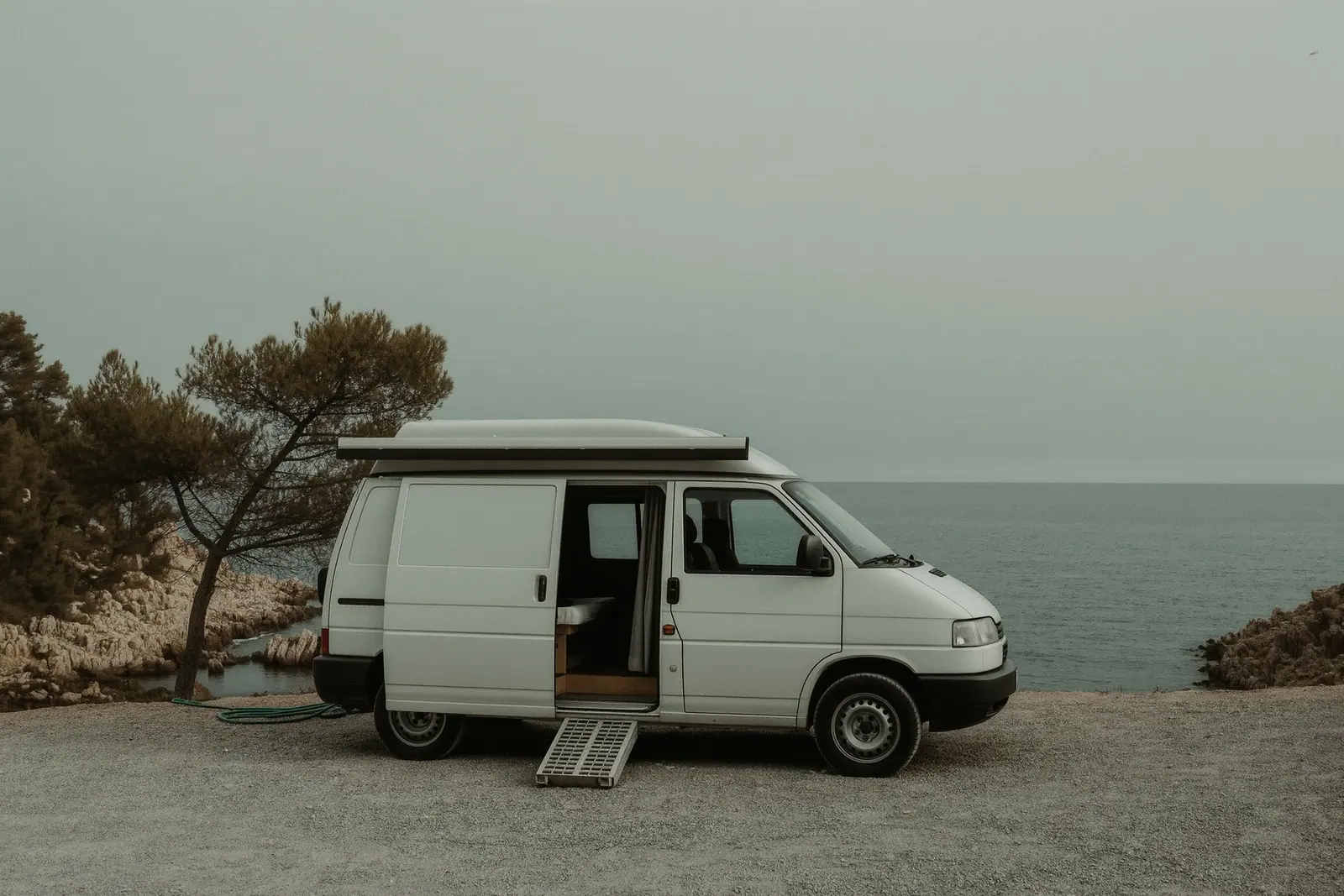
The east coast is the campervan trip everyone pictures: a string of calas from Portocolom up to Cala Mesquida, pine down to the sand, and a road that dawdles between them. It is a good trip. It is also the part of Mallorca that punishes a large vehicle hardest, and almost nobody finds that out until they are nosing up to a steel bar across a car park entrance.
Two constraints shape the whole week here: where you may sleep, and how tall your van is.
The height barrier problem
Most of the popular calas on this coast have a car park, and a great many of those car parks have a height restriction bar at the entrance. Two metres is common, and a bar does not negotiate.
That single detail reorders the entire hire decision. A pop-top van based on a standard panel-van chassis will get under most of them. A coachbuilt motorhome with a bed over the cab will not get under any of them, which means every stop becomes a roadside park and a walk, if there is a roadside to park on — and on the narrow approach lanes down to these coves, frequently there is not.
Get the height in metres from the hire company, in writing, and write it on something stuck to the dashboard. In a vehicle you have driven for two days you will not have an instinct for it.
Where you can actually sleep
This is the part that separates a Mallorca campervan trip from a French or German one.
Wild camping is not permitted. Beyond that, each municipality along this coast sets its own rules about overnight parking, and the councils around Santanyí, Manacor and Artà take an interest in vehicles parked overnight near the beaches. Spanish practice draws a line between a vehicle parked within its markings and a vehicle that is being camped in — the moment the awning comes out, the chairs go down or the levelling blocks appear, you are on the wrong side of it.
The licensed options on this island are few and they fill. Book them. The practical shape of a week here is a small number of pitched nights strung between days spent out at the calas, not a nightly improvisation.
Service points for fresh water and waste are also thin on the ground and some close outside the season. Fill and empty when you have the chance rather than when you need to.
A seven-day route that fits a small van
- Depot to Portocolom. Around an hour from the Palma side. A working harbour rather than a resort, with a long inlet and somewhere to park that is not a beach car park.
- Portocolom to Cala Mondragó. Short hop south. Natural park, proper parking, and two beaches joined by a footpath.
- The Santanyí calas. Cala Llombards, Cala s’Almunia and the walk down to Caló des Moro. Small, popular, and impossible to park a large vehicle near after nine in the morning.
- North to Cales de Mallorca and Cala Varques. Varques is a twenty-minute walk in from the road and there is no car park at the bottom. That is exactly why it is worth the day.
- Porto Cristo to Canyamel. The middle stretch, easier driving, better supplied.
- Artà and the Llevant peninsula. Cala Torta, Cala Mitjana and the tracks towards Cala Estreta. Dirt roads. Check what your cover says about them before you drive down one.
- Cala Mesquida and Cala Agulla, then back. The northern end of the run and the windiest — this corner catches the north-easterly when the rest of the coast is calm.
Seven days is right for this. Five is a rush and ten means repeating yourself, because the whole coast is about ninety kilometres end to end.
The season, which is not summer
| Period | Driving | Calas | Pitches | Verdict |
|---|---|---|---|---|
| Apr–May | Quiet lanes | Empty, sea still cool | Available | The best of the year |
| Jun | Getting busy | Good | Booking needed | Very good |
| Jul–Aug | Slow, hot, full car parks | Full by mid-morning | Scarce and expensive | Avoid if you can |
| Sep | Easing | Warmest water | Booking needed | Excellent |
| Oct | Quiet | Quiet, first rain | Some closing | Good, with a plan B |
August is the month to avoid and it is the month most people book. The car parks that have height barriers also have queues, the calas are full by mid-morning, and the day rate for the van is at its annual peak.

The thing people get wrong
They hire too much van. The instinct is to take the biggest one the budget allows, because it is a week of living in it, and on this coast that is exactly backwards. The van that fits under the barriers, turns round in a dead-end lane above a cala and parks in a normal bay in Artà on market morning is worth more than an extra half metre of headroom inside.
Two other things worth settling before you collect. Check whether one-way hire is possible if you want to finish at the northern end rather than driving back — on an island this size it usually is not worth the fee, but it is worth asking. And do the handover photographs properly, including the roof and the underside of the rear step, because those are the two places this coast leaves marks and the two places nobody photographs.
What to check before you book
- Get the van's exact height in metres in writing and write it on a card on the dashboard. Cala car parks on this coast use height barriers and 2 metres is a common limit.
- Ask the hire company which unsurfaced roads are excluded from cover. Several east-coast calas are reached by dirt track and damage there is often outside the policy.
- Book campsite or licensed pitch nights in advance. Mallorca has very few of them and they do not absorb walk-ins in summer.
- Check where the fresh water and waste points are on your route before you leave the depot. They are sparse on this island and not all are open out of season.
- Confirm whether the gas bottle is included, full, and swappable locally, and what the fridge runs on when the engine is off.
- Photograph the roof, the awning rail and the underside of the rear step at handover. Those are the three things this coast damages.
- Ask what the policy is on returning with a full waste tank. Some depots charge for emptying it.
Questions people actually ask
- Can you sleep in a campervan anywhere in Mallorca?
No. Wild camping is not permitted and individual municipalities set their own rules on overnight parking, with the coastal councils on this side of the island among the stricter ones. There is a distinction in Spanish practice between parking a vehicle overnight and camping in it, and putting out chairs, an awning or a table lands you clearly on the wrong side of it. Use licensed sites and check the local rules for each stop.
- How many campsites are there on Mallorca?
Very few — this is not a campsite island in the way parts of mainland Spain are, and the handful that exist are concentrated rather than spread along the coast. That scarcity is the single biggest constraint on a campervan week here and the reason the trip needs planning that a mainland trip does not.
- What size campervan works on the east coast?
A compact one, under two metres tall if you can get it. The height barriers on the cala car parks are the constraint, and above about six metres in length the approach roads to places like Cala Torta and Cala Varques become genuinely awkward. A small van with a pop-top opens up parking that a coachbuilt motorhome simply cannot use.
- Is a campervan cheaper than a hire car and hotels?
Not usually in high season on this island. Campervan day rates in July and August are high, licensed pitches are scarce, and you still pay for fuel and ferries. The case for it is the freedom to wake up somewhere different, not the arithmetic. In April, May and October the sums look much better and the coast is nicer anyway.